
Beyond the Monolith of Prey Drive
Calling a dog “high prey drive” may be convenient, but it compresses several distinct behavioral processes into one vague label. A dog that stares intensely at a moving bicycle, a terrier that grabs and shakes a toy, and a retriever that repeatedly delivers a ball may all be described as having prey drive, yet their observable behavior reflects different parts of an inherited motor sequence. The practical difference matters. A dog may be strongly drawn to movement but show little interest in biting, or may be highly motivated to retrieve while remaining socially relaxed around animals.
The behavioral architecture behind these responses is an ancestral hunting system inherited from wolf-like canids. It is not a single switch that is either turned on or off. Rather, it consists of linked action patterns, each influenced by sensory information, nervous-system thresholds, learning history, developmental experience, and context. Modern dogs still carry this blueprint, but human selection has altered its expression in remarkably specific ways. For owners comparing predatory motor patterns, the central insight is that the sequence can be fragmented, amplified, or interrupted without being eliminated.
These behaviors are also not dependent on hunger. Orienting toward movement, stalking, chasing, grabbing, or retrieving can be rewarding in its own right because the brain reinforces successful progress through a goal-directed sequence. Dopamine and related reward processes help explain why a well-fed dog may pursue a squirrel, repeatedly chase a thrown object, or become intensely focused on a fluttering leaf. Understanding that neurobiological reinforcement makes humane intervention more logical. The objective is not to morally condemn an inherited system, but to manage risk and provide safer ways for the dog to use it.
Deconstructing the Complete Ancestral Predatory Sequence
Raymond Coppinger”s model is useful because it breaks predation into recognizable stages rather than treating it as an undifferentiated “drive.” The complete sequence is commonly described as:
- Orient
- Eye
- Stalk
- Chase
- Grab-bite
- Kill-bite
- Dissect
- Consume
The sequence begins with detection. A sound, odor, flicker, or sudden movement captures the dog”s attention, producing orientation toward the potential target. The visual focus may then narrow into the “eye” stage, followed by stalking, in which the dog approaches carefully and often lowers the body. If the target moves away, pursuit can follow. Contact may produce a grab-bite, while repeated biting or shaking can progress toward killing, dissection, and consumption.
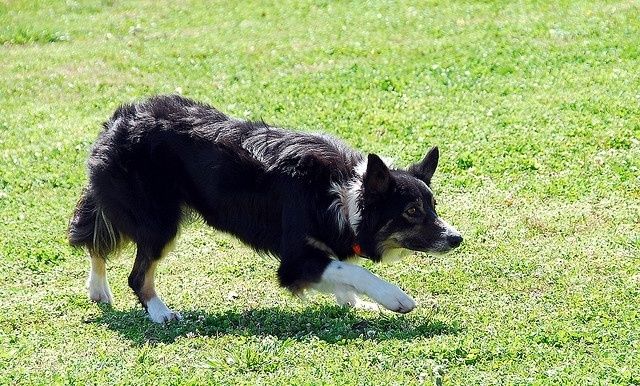
These links are sequential, but they are not mechanically inevitable. A dog can orient and stare without stalking, stalk without chasing, or chase without attempting to bite. Each portion may have reinforcing properties independent of eating. Anticipation, pursuit, successful capture of an object, and completion of a retrieve can all activate reward pathways. This is why predatory behavior should be distinguished from defensive aggression. Aggression often functions to increase distance from a perceived threat, whereas predatory behavior typically brings the dog closer to a moving target, although the two systems can coexist in a highly aroused animal.
Wild and free-ranging canids generally use the sequence in a demanding ecological context. They must search, assess risk, coordinate movement, conserve energy, and decide whether prey is worth pursuing. Domestic dogs experience a different environment. A pet may react to a jogger, a squeaking toy, or a household cat in a setting where no nutritional need exists and where the human family has created unusual movement patterns. Experience also shapes the response. Some dogs learn that chasing ends the fun, while others practice the behavior repeatedly and become more efficient. As explained in this overview of predatory behavior, different animals and objects can activate different parts of the sequence in the same individual.
Artificial Selection as an Evolutionary Editor
Artificial selection did not simply make some dogs more predatory than others. It edited the sequence according to human goals. Breeders repeatedly selected dogs that noticed specific cues, moved in particular ways, inhibited certain actions, or completed a specialized task reliably. Over generations, these preferences changed population-level tendencies. A herding dog that was highly responsive to movement but inhibited from killing livestock could be more useful than one that completed the entire hunting sequence. A terrier able to enter a confined space, seize quarry, and persist through resistance was selected for a very different profile.
Canine behavioral genetics supports this broader interpretation. Dog breeds are relatively closed populations with substantial differences in morphology and working behavior, making them useful for studying inherited variation. A review of canine behavioral genetics in Canine Behavioral Genetics describes how restricted gene flow and intense selection helped produce specialized behaviors such as herding, guarding, pointing, retrieving, tracking, and hunting. These findings do not mean that one gene dictates a behavior. They indicate that inherited variants can influence thresholds, attention, motor coordination, persistence, temperament, and trainability, all of which affect how a sequence appears.
More recent genome-wide work illustrates both the promise and the limits of this research. A study of 268 whole-genome sequences from 130 breeds identified multiple genomic regions associated with herding and candidate genes linked with predation-related breed groupings, including JAK2, MEIS1, and LRRTM4. The authors also found associations involving genes connected to nervous-system development and temperament, as reported in the Frontiers study of canine behavioral genetics. Such associations describe probabilities across populations, not an individual dog”s destiny. Environment, socialization, health, reinforcement, and learning remain essential parts of the behavioral outcome.
| Functional group | Commonly emphasized links | Typical working advantage |
|---|---|---|
| Herders | Orient, eye, stalk, chase, with inhibition of capture | Controlling and moving livestock without routinely injuring them |
| Retrievers | Orient, chase, grab, carry, and return | Bringing objects or game back to a handler with a soft mouth |
| Pointers | Search, orient, and sustained visual focus | Locating and indicating game without immediately pursuing it |
| Terriers | Orient, chase, grab-bite, persistence, and shaking | Entering confined spaces and dispatching small quarry |
| Livestock guardians | Orient, assess, patrol, and selectively respond | Detecting threats while remaining integrated with livestock |
Breed group descriptions are starting points, not individual assessments. Within any breed, dogs vary considerably, and mixed-breed dogs may inherit combinations that do not fit a simple category. Responsible breeding therefore requires more than assuming that a pedigree guarantees a predictable temperament. Direct observation of relatives, careful evaluation of recovery from arousal, health screening, and attention to functional behavior are more informative than labels alone.
When Truncated Circuits Misfire in Domestic Life
Many everyday behavior problems arise because a specialized sequence meets an unsuitable modern trigger. Herding dogs may become caught in an eye-stalk loop when they watch children run, bicycles pass, or feet move rapidly under a table. The dog may be intensely focused without intending social harm, yet the resulting pursuit can frighten people and create a serious collision risk. Visual fixation can also become self-reinforcing because every successful stare, rush, or interruption of movement provides practice.
Other dogs show a motor-pattern spill in which chase and grab behaviors transfer to objects or animals that were never part of the breed”s original work. A small companion animal, cat, jogger, skateboard, or bicycle may become the target. A dog can be affectionate with familiar household members and still pose a danger to a fleeing animal. The emotional presentation may look excited rather than hostile, but the function and consequences still require careful management. Predatory behavior is not defined by whether the dog appears angry.
Frustration adds another layer. When a leash, fence, window, or handler blocks an activated sequence, the dog may bark, lunge, spin, whine, or redirect onto a nearby person or animal. This does not prove that the dog is “dominant” or morally untrustworthy. It indicates that high arousal, blocked access, and limited behavioral alternatives are interacting. Punishment can intensify the problem by adding pain, fear, or conflict while leaving the original movement trigger unchanged.
- Visual fixation that escalates rapidly when the target moves
- Repeated rehearsal of chasing bicycles, wildlife, or small animals
- Grabbing, shaking, or carrying behaviors directed toward inappropriate targets
- Frantic barking or lunging when access to a moving target is blocked
- Difficulty eating, responding, or disengaging once arousal has peaked
A sudden increase in chasing, irritability, or inability to disengage should also prompt a health review. Pain, sensory changes, neurologic disease, sleep disruption, medication effects, and age-related changes can alter thresholds and impulse control. Genetics may create a predisposition, but the current behavior reflects the whole dog in the current environment.
Ethological Channeling and Modern Behavioral Interventions
Effective intervention begins with identifying which links are most strongly expressed. A dog that locks onto motion may need carefully structured visual disengagement work and controlled movement games. A dog that thrives on grabbing and carrying may benefit from retrieve routines, legal tug, and object discrimination. A dog that searches persistently may find nosework more regulating than repetitive running. The best outlet is not necessarily the most physically exhausting one. It is the activity that uses the relevant motor and sensory systems while preserving safety and handler control.
- Flirt poles: Useful for controlled chase and grab work when introduced gradually, used on stable footing, and paired with clear start, stop, and release cues.
- Treibball: Provides movement control, targeting, and handler communication for dogs drawn to herding-like pursuit without involving livestock.
- Nosework: Shifts the dog from visual pursuit toward searching and scent-based problem solving, often offering a lower-conflict outlet.
- Structured retrieve: Builds chase, grab, carry, return, release, and reorientation to the handler into one predictable routine.
Timing is central. Handlers should learn to recognize the pre-motor transition from orienting to focused eye contact. Early signals may include a head turn, body stillness, weight shifting forward, closed mouth, intense visual fixation, or a sudden reduction in responsiveness. At that stage, the dog may still be able to take food, turn away, follow a target, or perform a familiar cue. Once the dog is lunging or chasing, teaching is more difficult and safety management becomes the priority.
Training should build reliable disengagement under gradually increasing distraction. Begin at a distance where the dog can notice the trigger and still respond, then reinforce looking back, moving away, settling, and choosing the handler. Use long lines, secure fencing, barriers, and carefully selected environments to prevent rehearsal. Recall training should be layered onto management rather than treated as a substitute for it. A recall is a learned behavior, while the movement of prey can be a powerful inherited trigger.
Force-free methods are not permissive. They combine prevention, clear criteria, reinforcement, and realistic risk assessment. If a dog has injured another animal, cannot disengage from moving targets, or redirects onto people, individualized help from a qualified behavior professional is appropriate. The goal is not to expose the dog repeatedly until it “gets over” predation. The goal is to create a stable pattern in which the dog can perceive a trigger, regulate arousal, and choose a safe alternative.
Living in Harmony with Inherited Instincts
Canine predatory behavior reflects both ancient survival biology and centuries of purposeful human partnership. Selective breeding has produced dogs that point, retrieve, herd, guard, search, pursue, and control movement, often by emphasizing one section of a sequence while suppressing another. These inherited tendencies are meaningful, but they are not fixed predictions. A dog”s actual behavior emerges from genetics interacting with development, learning, health, environment, and immediate arousal.
A practical roadmap is straightforward: observe which stimuli activate the dog, identify the earliest pre-motor cues, prevent unsafe rehearsal, provide a species-appropriate outlet, reinforce disengagement, and seek professional guidance when risk exceeds ordinary training needs. Replace moral judgments such as “bad” or “aggressive” with functional questions about what the dog is attempting to do and what consequence is reinforcing it. Respecting the sequence does not require surrendering to it. With thoughtful breeding, informed management, and humane training, inherited predatory patterns can become safer, clearer, and more compatible with domestic life.